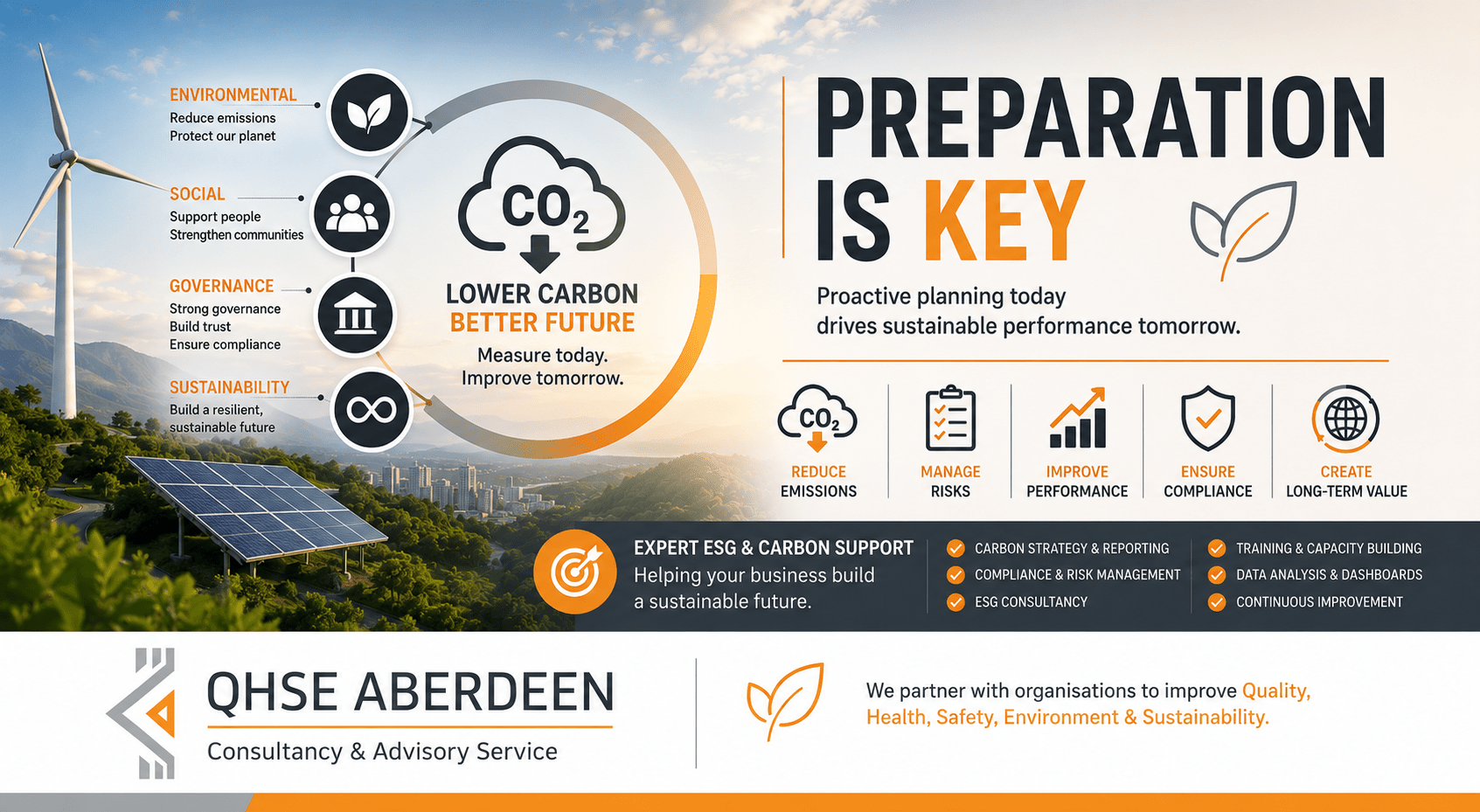
“If someone asked your organisation for its carbon footprint tomorrow, could you provide it?”
Welcome
Welcome to the August edition of the QHSE Aberdeen Knowledge Hub Newsletter.
Each month we explore one of the key topics affecting organisations across industry, helping businesses stay informed and prepared for changing customer expectations, legislation and best practice.
Previous editions have covered:
- 🔐 Information Security & ISO 27001
- 🌍 Environmental Management & ISO 14001
- 🦺 Health & Safety & DSEAR
- 📈 Quality Management & ISO 9001
This month we’re looking at a topic that is rapidly moving up the agenda for organisations of every size:
ESG, Sustainability and Carbon Reporting.
Many businesses don’t think about ESG until a customer, tender or Board asks for the information. By then, time is usually against them.
What is ESG?
ESG stands for Environmental, Social and Governance.
It is a framework used by organisations to measure and demonstrate how responsibly they operate, not only financially, but also in terms of their environmental impact, how they treat people and how effectively they govern their business.
Although ESG is often associated with large multinational organisations, it is becoming increasingly relevant to businesses of all sizes.
Customers, investors, lenders, insurers and supply chain partners are all placing greater emphasis on responsible business practices and are increasingly requesting evidence to support these commitments.
The Three Pillars of ESG
🌍 Environmental
How your organisation manages its environmental impact.
Examples include:
- Carbon footprint
- Energy efficiency
- Climate change strategy
- Waste management
- Biodiversity
- Resource efficiency
👥 Social
How your organisation supports and values people.
Including:
- Health & Safety
- Employee wellbeing
- Equality and diversity
- Responsible supply chains
- Community engagement
- Fair employment practices
⚖ Governance
How your organisation is managed.
Including:
- Legal compliance
- Ethical business practices
- Risk management
- Anti-bribery and corruption
- Corporate governance
- Transparency and accountability
Strong performance across all three areas helps organisations become more resilient, efficient and attractive to customers and investors alike.
Sustainability is the principle that underpins ESG.
The United Nations Brundtland Commission famously defined sustainability as:
“Meeting the needs of the present without compromising the ability of future generations to meet their own needs.”
For organisations, sustainability means balancing commercial success with environmental responsibility and social value, ensuring that business growth can continue without creating unnecessary long-term impacts.
Increasingly, organisations are recognising that sustainable business practices can also improve efficiency, reduce costs and strengthen customer relationships.
What is Carbon Reporting?
Carbon reporting forms part of the Environmental pillar of ESG.
It measures the greenhouse gas emissions generated by an organisation’s activities, helping businesses understand where emissions are produced and identify opportunities to reduce them.
For many organisations, carbon reporting begins by calculating:
Scope 1
Direct emissions from owned or controlled sources.
For example:
- Company vehicles
- Gas heating
- Fuel used on site
Scope 2
Indirect emissions from purchased energy.
Such as:
- Electricity
- Purchased heating or cooling
Scope 3
Indirect emissions generated throughout the wider business and supply chain.
Including:
- Business travel
- Employee commuting
- Purchased goods and services
- Waste disposal
- Contractors
- Supplier activities
For many businesses, Scope 3 represents the largest proportion of their carbon footprint and often provides the greatest opportunity for improvement.
Does Every Organisation Need ESG Reporting?
One of the most common questions we hear is:
“Does this apply to us?”
The simple answer is not necessarily.
Not every organisation has a legal obligation to produce formal ESG reports or carbon disclosures.
However, many organisations are now being asked for ESG information because:
- Customers require it during supplier approval processes.
- Tender submissions increasingly include sustainability questions.
- Parent companies require carbon data.
- Investors and lenders are considering ESG performance.
- Businesses want to improve efficiency and reduce operating costs.
For many SMEs, ESG has become a commercial requirement rather than simply a regulatory one.
Being prepared before those questions arise places organisations in a much stronger position.
Don’t Wait Until You’re Asked
Many organisations first contact us after receiving an unexpected request for:
- A carbon footprint
- ESG policy
- Sustainability objectives
- Scope 1, 2 & 3 emissions
- Environmental performance data
- Net Zero commitments
Unfortunately, by that stage there is often very little time available to gather the required information.
Preparing in advance allows organisations to understand their environmental impact, identify opportunities for improvement and respond confidently to customer requests.

Setting Meaningful Sustainability Goals
Developing an ESG strategy doesn’t mean trying to achieve everything at once.
Successful organisations begin by understanding where they are today before setting realistic, measurable objectives.
We encourage businesses to establish SMART objectives that are:
- Specific
- Measurable
- Achievable
- Relevant
- Time-bound
Where appropriate, these objectives can also support the United Nations Sustainable Development Goals (SDGs), including:
- Good Health and Wellbeing
- Reduced Inequalities
- Climate Action
- Responsible Consumption
- Peace, Justice and Strong Institutions
The important point is that ESG should become part of everyday business planning rather than a once-a-year reporting exercise.
You’re Probably Already Doing More Than You Think
One of the biggest misconceptions about ESG is that organisations have to start from scratch.
In reality, many businesses are already carrying out activities that contribute towards good ESG performance, including:
- Monitoring energy consumption
- Supporting employee wellbeing
- Investing in Health & Safety
- Managing waste responsibly
- Working with approved suppliers
- Operating certified ISO management systems
The challenge is often not doing these things—it’s measuring them, reporting them consistently and demonstrating continual improvement.
Client Spotlight
Congratulations to CRANETEK SERVICES LIMITED on achieving another successful ISO 9001, ISO 14001 and ISO 45001 surveillance audit with zero findings. A fantastic result that reflects the team’s ongoing commitment to continual improvement and operational excellence. We’re proud to have supported them throughout their certification journey and look forward to continuing our partnership. Well done to everyone involved.

When asked for feedback they said…
We have been working with QHSE Aberdeen for around 3 years and have found the level of service and professionalism to be exemplary. We would have no hesitation to recommend QHSE Aberdeen to anyone looking for their services and assistance.
Much appreciated and thank you for your kind words.
Client Success Story: ESG Reporting That Delivers Real Business Value
We are now supporting one of our clients into their third year of ESG and Carbon Reporting. While we can’t identify the organisation due to confidentiality agreements, their journey demonstrates how a structured approach to sustainability can create measurable business value far beyond compliance.
Several years ago, the business recognised that customers, investors and stakeholders were increasingly seeking evidence of strong environmental, social and governance performance. Rather than waiting for these expectations to become contractual or regulatory requirements, they chose to take a proactive approach.
Working alongside their leadership team, we established a robust ESG framework and completed detailed Scope 1, Scope 2 and relevant Scope 3 greenhouse gas assessments, creating a reliable baseline from which progress could be measured year on year.
As the programme has matured, the benefits have extended well beyond carbon reporting. The organisation has identified opportunities to improve operational efficiency, reduce unnecessary costs, strengthen internal governance and provide meaningful ESG reporting to the Board.
Their investment in ESG has also enhanced the quality of tender submissions, enabling them to demonstrate credible environmental performance and continual improvement to customers and prospective clients.
Importantly, having a well-established ESG strategy supported by measurable data has strengthened the organisation’s position when engaging with investors, providing greater confidence in the business’s long-term sustainability and growth strategy.
Now in its third year, the focus is firmly on continual improvement—tracking performance, identifying new opportunities to reduce environmental impact and embedding sustainability into everyday business decisions rather than treating it as a standalone reporting exercise.
This partnership shows that effective ESG reporting isn’t simply about producing another document. Done properly, it becomes a practical business management tool that supports better decision-making, improves operational performance, enhances investment opportunities and provides a genuine competitive advantage.
ESG isn’t just about protecting the future—it’s about building a stronger, more resilient business today.
Training & Development

Compliance Update
Capturing environmental information throughout the year makes reporting significantly easier.
Consider monitoring:
- Electricity consumption
- Fuel usage
- Waste volumes
- Business mileage
- Supplier information
- Employee travel
Small improvements made consistently often deliver significant long-term benefits.
Looking Ahead
Customer expectations continue to evolve.
Increasingly, organisations are expected to demonstrate not only what they do, but how responsibly they do it.
Whether that’s through quality, health and safety, environmental management, information security or ESG reporting, organisations that prepare today will be far better positioned for tomorrow’s opportunities.
“QHSE Myth of the Month”
❌ Myth: “ESG only applies to large companies.”
✅ Reality: Many SMEs are now being asked for ESG and carbon information by customers, procurement teams and supply chains. Even where there is no direct legal requirement, being able to demonstrate good ESG practices can improve competitiveness, strengthen customer relationships and support tender success.
Final Thoughts
At QHSE Aberdeen, we believe ESG should never become a tick-box exercise.
Done well, it helps organisations become more efficient, reduce costs, strengthen customer relationships and build a more resilient business for the future.
If you’ve been asked for ESG information, are considering measuring your carbon footprint, or simply want to understand where your organisation stands, we’d be delighted to help.
The best time to prepare your ESG strategy wasn’t when the questionnaire arrived on your desk………it was six months before.
The second-best time is today.
Thank you for reading this month’s edition of the QHSE Aberdeen Knowledge Hub Newsletter.
Until next month…
Stay Safe. Stay Compliant. Stay Future Ready.
The QHSE Aberdeen Team
If you are not already subscribed to our Newsletters, go to the bottom of the QHSE ABERDEEN LinkedIn page and tick subscribe. You can also see past newsletters online too.